
01
An agent should have a specific job and limited authority
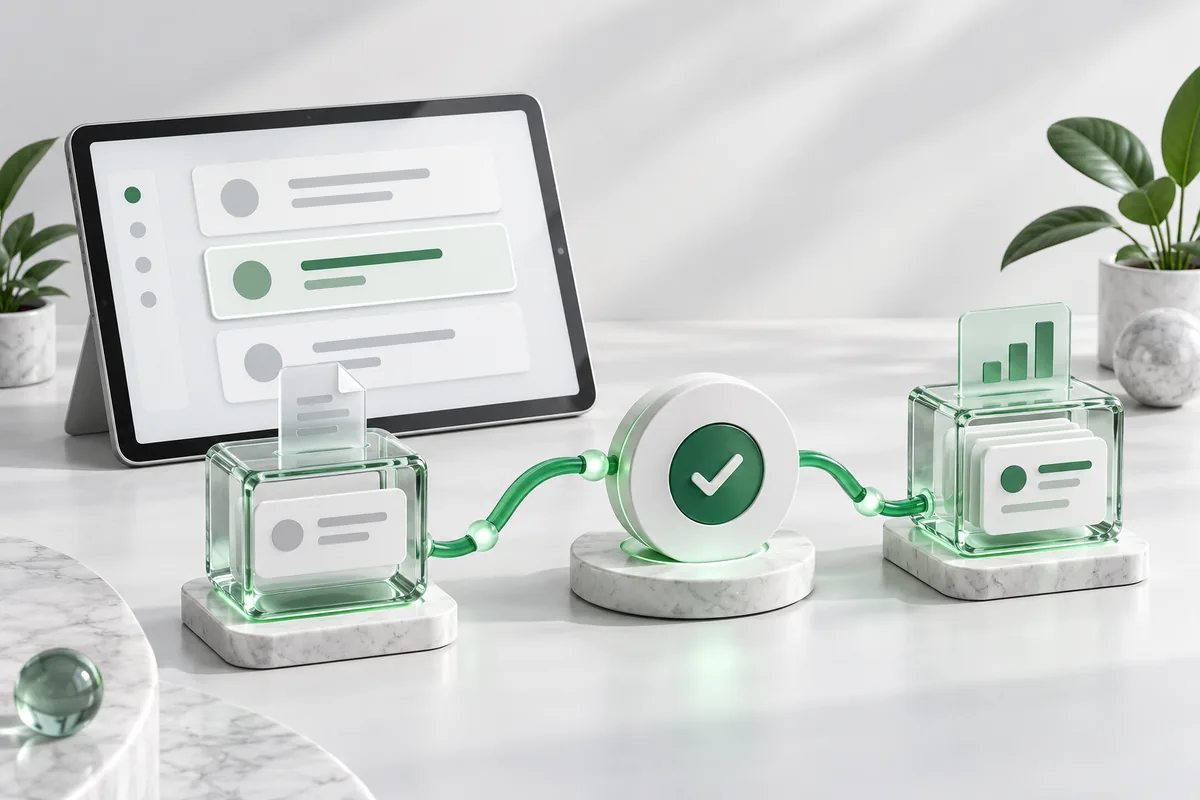
A chatbot returns information. An agent can call tools and change records, which introduces additional failure modes. Start with a bounded job: suggest a support category, draft a CRM update or prepare a document checklist. Define the allowed systems and actions before choosing an orchestration library.
A hypothetical Raleigh B2B software team might use an agent to prepare a renewal summary from support tickets and account notes. Reading authorised records and drafting a summary are different permissions from changing contract terms or sending an email. The first version can remain read-only until its output is useful and sufficiently tested.
02
Map the workflow, exceptions and approval points
Document the trigger, required inputs, source of truth, output and owner. Identify cases where information is missing or contradictory. Decide whether the agent should request clarification, route the task to a person or stop. For external communication, payments or consequential record changes, an explicit approval gate may be necessary.
A CRM integration should validate the account and record identifiers before writing. Use idempotency and bounded retries where supported so a failed request does not produce duplicate actions. Keep tool permissions narrower than a general administrator account, and avoid giving the agent credentials in ordinary prompt text.
- Treat documents and tool responses as data, not authority to expand permissions.
- Set limits for attempts, execution time and usage cost.
- Record who approved an action and the resulting system change.
03
Test behaviour, not just answer quality
Agent evaluation needs scenarios where a tool fails, a user lacks permission, a document contains conflicting instructions or an action has already completed. Measure whether the workflow reaches the right state without unauthorised changes. Include the rate of human intervention and the time spent correcting output in the business case.
A pilot can begin with historical or synthetic examples, then move to a supervised environment with approved inputs. Define a stop condition before the pilot starts. If the agent cannot distinguish a duplicate task or reliably respect its action boundary, reduce its authority or retain a conventional workflow.
04
Release gradually with an operational owner
Use a staged rollout: read-only recommendations, supervised actions and then a limited live workflow if the evidence supports it. Monitoring should show task status, tool errors, approvals and consumption. A kill switch and manual fallback let the business continue when the agent or a connected service is unavailable.
Codazz is not a Raleigh-based office; we deliver remotely with collaboration and data access agreed per engagement. The proposal should identify integration owners, model-provider settings, operational costs and responsibility for approving future changes. No agent should be described as a guaranteed replacement for a role or a guaranteed source of savings.
Questions before you hire
Can an AI agent update our CRM?
Potentially, if the CRM supports suitable access and the scope defines the permitted records and actions. We start with controlled permissions, validated inputs, logging and approval where necessary.
Do we need a multi-agent system?
Not by default. A single workflow or conventional integration may be easier to test and operate. Additional agents need a clear responsibility and demonstrated value.
How do you assess return on investment?
Compare task time, correction effort, intervention rate and operating cost against the current process. Results depend on the workflow and pilot evidence; savings are not guaranteed.
What happens if a tool or model is unavailable?
The agreed design should include bounded retries, visible failure status, a manual fallback and an operational owner. A production release must test these paths.
Raleigh project planning resources
 Choosing a Raleigh software partner: brief, scorecard and handoffRead the guide →
 Planning a Raleigh SaaS MVP: scope, budget model and release gatesRead the guide →
Market context comes from the sources below. The workflow examples on these pages are illustrative, not local client case studies.
- Wake County Economic Development: Raleigh’s advanced industries (2025)
- Research Triangle Park: company directory
Content updated . Codazz serves clients worldwide; this is a US city campaign.